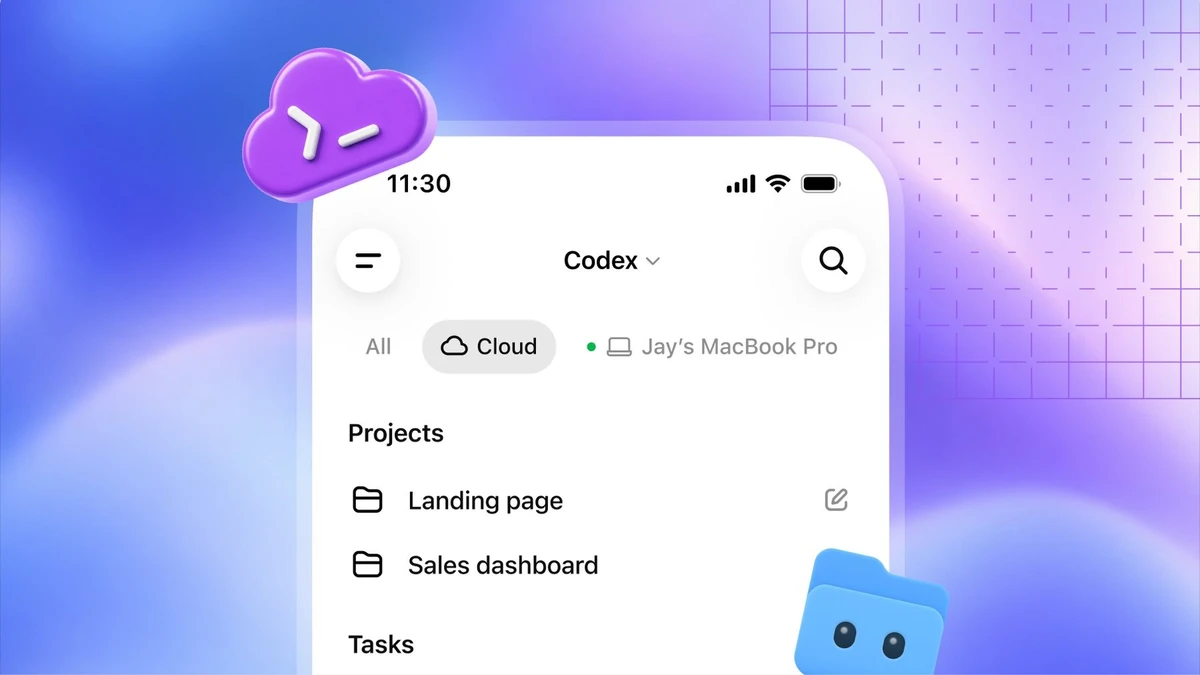
OpenAI Codex no longer needs your computer to stay on. At DevDay in San Francisco on 29 September, OpenAI said developers can now run Codex on a computer, remotely from a phone, or in the cloud from any device, using reusable development environments that give a team one shared setup with approved settings and permissions. Its new security tool goes a step further and prepares fixes in the cloud, in OpenAI's own words, even with your laptop closed.
The announcements show where AI coding tools are heading. They are moving from an assistant that answers inside your editor to a service that keeps working on a schedule, checks code before a person does, and is priced by how fast you need the answer. For individual developers and small teams, that brings real gains and a few new costs.
What Changed in Codex at DevDay
The headline change is where OpenAI Codex does its work. Codex in the cloud is available on the Plus, Pro, Business, Healthcare, Education and Enterprise plans, according to OpenAI's DevDay recap. Phone control through the ChatGPT app arrived in May, The Decoder notes; what is new is the reusable environment, which lets a task start quickly without each developer rebuilding the same configuration.
The command-line tool changed too. The refreshed Codex CLI lets you start and steer tasks by voice, and a new /agents view makes it easier to hand out work and follow several tasks at once. OpenAI also improved prompt editing, session resuming and work with Git worktrees, and cleaned up the terminal interface. The new CLI is available on all plans.
Code review got its own space. The ChatGPT desktop app now has a review view where you can read summaries, step through diffs and ask Codex about possible problems before leaving feedback on GitHub pull requests or GitLab merge requests. With automatic reviews switched on, Codex takes a first pass in the cloud while you are away. That feature is available on all plans as well.
A Security Scanner That Runs on a Schedule
Codex Security Cloud extends OpenAI Codex to the people who defend a codebase. It scans entire GitHub repositories on demand or on a schedule, keeps checking new commits as they arrive, investigates what it finds, removes duplicate findings and prepares fixes in the cloud. It is available to Pro, Business, Enterprise and Edu users on desktop and web.
It also opens a door that used to need paperwork. Cloud users get access to the Daybreak Blue models without a separate Daybreak application, OpenAI says. The Decoder describes Daybreak Blue as the defensive tier of OpenAI's cybersecurity programme, built for tasks such as malware analysis, which previously required identity verification. In July, OpenAI had already released the Codex Security CLI as an open-source tool for checking repositories from the command line and in CI/CD pipelines.
For a small team, the significance is less about any single finding than about routine. Security review is often the step that slips when there are only a few developers and a deadline. A scanner that runs on every new commit, whether or not anyone remembers to start it, turns an occasional audit into a habit.
Agents That Can Use Software, Not Just Write It
The Agents API, in public beta since 11 September according to The Decoder, now supports computer use, so developers can build agents that operate software through its interface to finish a task. It also brings Codex's multi-agent features, tool search, tool calling and context compaction, which condenses long contexts automatically, and OpenAI runs the infrastructure underneath. Computer use had already been available in Codex and ChatGPT on macOS since April and on Windows 11 since May.
The same capabilities are reaching other clouds. OpenAI worked with Amazon on Bedrock Managed Agents, which takes the core of the Agents API and adapts it to run natively in AWS, so developers can build OpenAI agents that run entirely inside Amazon's cloud.
A smaller release may matter as much. The Decisions API, in limited preview, uses OpenAI's low-cost Luna model to pick from a fixed set of answers that a developer defines, using text or image context. InfoQ lists its intended uses as classification, request routing and choosing an agent's next action. It is a cheap, fast way to make the many small decisions that sit between the big ones.
The Price Split Behind the Features
The model news pulls in two directions. GPT-6.1 Sol, an upgrade to GPT-6 Sol, is pitched at agentic coding, computer use and professional work, and OpenAI says it delivers near-Astra intelligence at a fifth of Astra's standard input and output prices. In the API it costs $2 per million input tokens and $10 per million output tokens, the same as its predecessor, The Decoder reports, and InfoQ puts cached input at $0.10 per million tokens. It is available to all API, Plus, Pro, Business, Enterprise and Edu users.
At the other end sits Ultrafast, a premium speed tier. OpenAI says it generates tokens up to eight times faster in Codex, at 300 tokens per second, and up to six times faster in the API. The Decoder reports that API pricing for Ultrafast is six times the standard rate, which works out to $60 per million input tokens and $300 per million output tokens for GPT-6 Astra. Inside ChatGPT Work and Codex, Ultrafast is limited to Enterprise and a new $500-a-month Pro 500 plan.
The existing $200 Pro plan changes as well. According to The Decoder, it now includes ten times Plus usage in ChatGPT Work and Codex instead of twenty times, and GPT-6 Pro messages are halved from 200 to 100 a week. Existing customers keep their current limits for a transition period and receive a one-time credit.
Who Gains and Who Pays More
For most people the direction is positive. A near-frontier coding model at a fifth of the top model's price lowers the cost of trying AI-assisted development, and cloud environments mean the heavy lifting no longer depends on owning a powerful machine that stays switched on. On a Plus plan, a solo developer can start a task from a phone and check the result later.
The fastest and most autonomous features, though, are concentrated at the top. Ultrafast and the new Agents API features inside Codex and ChatGPT Work sit on Pro 500 and Enterprise, and the $200 plan now buys half the Codex usage it did. Capability is spreading down the price list while speed and autonomy move up it, and anyone choosing a plan should check which side of that line their work falls on.
Where AI Coding Tools Are Heading Next
Put together, the DevDay releases sketch the next stage of AI coding tools: work that continues in the cloud after you log off, reviews and security scans that run on a schedule, several agents working at once under one person's direction, and small decision models handling the routing in between. OpenAI says its products reach a collective 1.2 billion weekly users, which gives these tools a very large starting audience.
The business impact is already visible. Agentic coding tools led 32% of organisations to skip at least one software purchase, according to McKinsey figures covered in Agentic Coding Tools Stopped One in Three Software Purchases. As tools like OpenAI Codex take on review and security work as well as writing code, that substitution may widen.
The practical step for developers is simple. Try the cheaper model on real tasks before paying for speed, turn on automatic reviews and scheduled scans where your plan allows them, and keep a person in the loop for the decisions that matter. The tools now work while you are away; the judgement about what ships is still yours.